




Since 1835, Mining Journal has recorded the turning of history's wheel—from coal, iron, and steam to critical minerals, renewable energy, and AI. This article is the second in a series marking its 190th year, tracing how a small London title helped shape, and survive, nearly two centuries of increasingly rapid Industrial transformation.
________________________________________
In London on New Year's Eve, 1850, St Paul's Cathedral's 142-year-old clock groaned as its iron wheels laboured to keep time for the dying minute of a half century rebuilt with coal and steam.
For 15 years, editor and proprietor Henry English wielded his Mining Journal like an iron gad to beat at the clandestine caprock covering Great Britain's mining, rail, and Industrial sectors—once so largely ignored by the City.
YOU MIGHT ALSO LIKE
That was impossible now. Britain, and the world, had changed too much.
The clamouring brute force of Industrialisation, born in and once largely confined to England's Midlands and North, was now heaving at the sites of the City's old gates and clawing its way to every corner of the globe.
When the half century began, the world had not seen a full-scale working railway coal-fired steam locomotive—with the first built in 1802 for the Coalbrookdale ironworks in Shropshire in England's West Midlands.
Now, they seemed to be everywhere.
In the west, American rail reached all the way to the young city of mud and lumber, Chicago; its two-year-old tracks built largely as a conduit for the wealth of the lead mines in Galena, Illinois.
To the east, the world's longest double-track railway was just months away from connecting the Russian cities of St Petersburg and Moscow.
In Britain itself, railways threaded throughout the country so quickly that even the Square Mile of the City around St Paul's was closely hemmed with iron tracks and skirted by regular billowing passenger trains.
Although the dates are debated, historians typically place this mid-century mark as either the end of the First Industrial Revolution, or the transitional period, before steaming headlong into the Second.
A golden cross, a chimney stack, and a palace of glass
The Cathedral still stood as the City's giant white tiara with no taller structure in London—even soot stained as it was from a couple of thousand stationary steam engines at workhouses and factories across the metropolis.
But eight years prior, in 1842, a new Industrial Saint claimed the title of the Kingdom's tallest crowning achievement.
Up in Glasgow, St Rollox Chemical Work's chimney stack, Tennant's Stalk, reached 70.5ft closer to the heavens than St Paul's golden cross, and took the title as the UK's tallest building from the Salisbury Cathedral.
At 435.5ft, it ranked among the tallest structures in the world.
St Paul's still had large stone shoes to fill when it came to footprints, taking up an area of 1.5 acres—the biggest of any building in the UK.
Just three miles away, however, over in Hyde Park, that was about to be beaten nearly 13 times over by the world's first megastructure of glass and iron; a temple to Industry.
A Crystal Palace covering 19 acres was under rapid construction to host The Great Exhibition of the Works of Industry of All Nations from May to October of 1851.
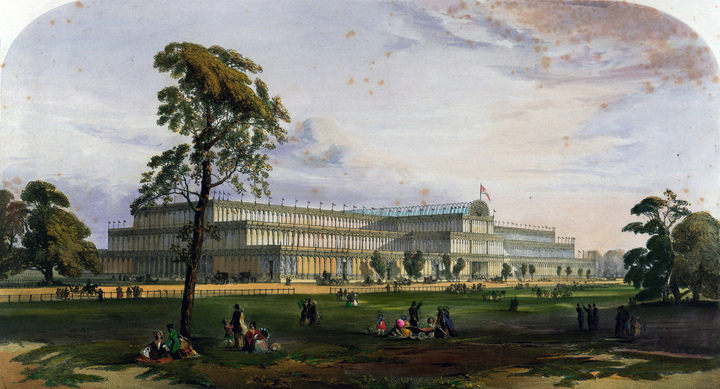
Column inch by column inch, for a decade and a half, The Mining Journal editor had chipped away to let even the smallest glimmers of light shine on Britain's industrial sectors in the forms of greater safety scrutiny, investment, and understanding—and now a literal glass palace was being built to showcase it.
Writing in mid-1850, English argued that the event promised to give "the practical, the mechanical, and all the manual arts such an impulse and acceleration as otherwise, and in the ordinary course of things, they might not receive in the entire lifetime of a generation".
Mining and its allied industries were, at last, being publicly acknowledged—if still imperfectly.
Capitalists at the barbarian's mine gate
Cultural attitudes were also shifting. English observed that it was "less than half a century since" colliery workers had been viewed as scarcely removed from "barbarism", and metal miners as "steeped in ignorance" and possessing little knowledge beyond their immediate tasks.
In the first issue of Mining Journal in 1851, English took the occasion to congratulate readers on the "vast strides" made in the previous year, and on the growing importance attached by capitalists and influential social groups to Britain's "subterranean wealth"—an importance, however, he argued, was "certainly not greater" than was "pre-eminently its due".
As St Paul's old clock struck midnight and the bells rang out over a city increasingly choked by sulphurous smog, Britain's mining sector remained severely underregulated and plagued by death and deception and riddled with self-interest and ignorance.
For English and Mining Journal, it was not the time for complacency. If anything, the spotlight needed to grow brighter.
In 1851, the Crystal Palace offered the lens to do so.
Risings and revolutions
With Britain producing roughly two-thirds of the world's coal and over half of its iron, the Government had largely abandoned the protectionists instincts of the 1830s and was pressing other nations to lower trade barriers and let British goods flow in.
First-mover advantage in Industrialisation, combined with relative political and societal stability in the first half of the 19th Century, underpinned its confidence.
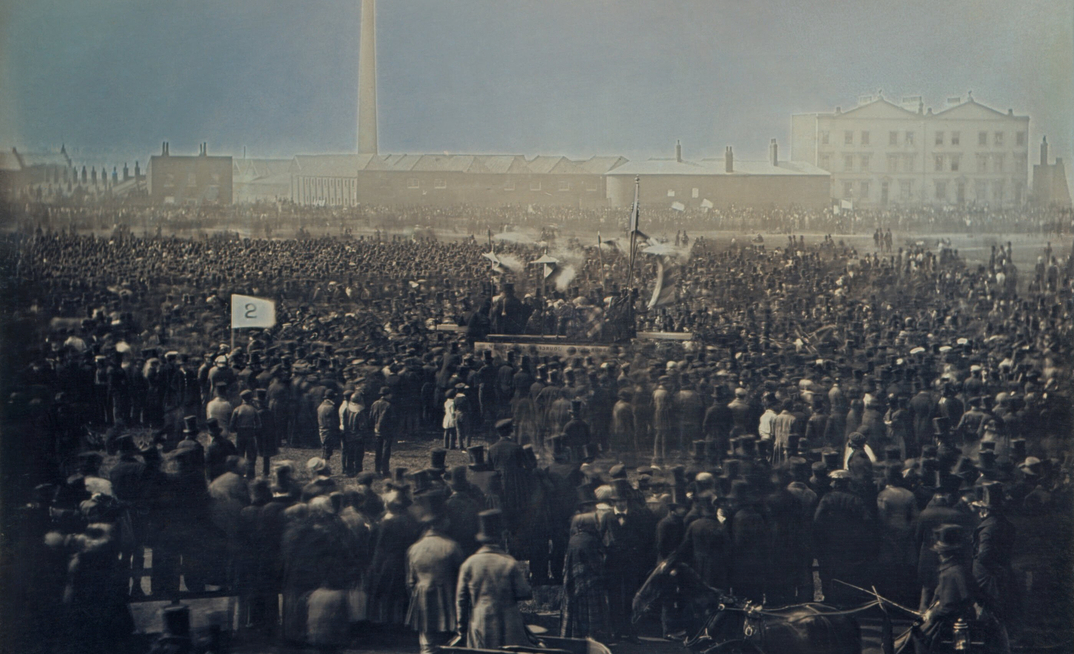
That stability, however, was neither absolute nor contested. Britain experienced a significant continuous thread of working-class agitation and political reform movements that spilled over into violent social conflict throughout the half-century.
Between 1811 and 1816, the Luddite risings saw textile workers attack machinery they believed threatened their livelihoods; several dozen were shot or executed, while factory owners, soldiers, and guards were also killed.
In 1819, the Peterloo Massacre left at least 18 dead and hundreds injured when cavalry charged a crowd of reformers demanding political representation.
In 1831, in Merthyr Tydfil, South Wales, tens of thousands of workers seized control of the iron-making town; with accounts of some two dozen workers being killed when it was reclaimed, with others executed, imprisoned, or sent to Australia.
By 1851, these events lay some distance in the past, and they appeared modest when set against the revolutions that swept continental Europe in 1848-49, where tens of thousands were killed. Having narrowly avoided also being swept up in those revolutions, Britain's governing class presented the country as both economically advanced and socially well managed.
A message in a glass building
The Great Exhibition was designed, in part, to drive that message home, and, perhaps more importantly, abroad.
To some conservative figures, the plan seemed reckless. There was a fear amongst them that it would serve as something of a self-gifted trojan horse for French socialists and German radicals to export revolution to British Chartists.
The British establishment considered that a risk worth taking. The glass structure was intended to signal transparency and confidence: Britain, it implied, had industrialisation under control and advanced beyond catching by its peers.
English saw an opportunity. If domestic campaigning had failed to deliver meaningful reform in mine safety and education, perhaps international comparison and embarrassment in front of the French would.
Mining Journal's data, perhaps the most complete set of the time—compiled in an absence of any comprehensive official system—recorded 464 accidents, 273 injuries, and 632 deaths in British mines during 1850. These figures are almost certainly well short of the total.
In the decade and a half of campaigning for reform, there was some legislative progress—if you can call it that.
There was the Mines Act of 1842 which forbade all women and girls from working underground as well as any boy under the age of ten. But it left most safety matters untouched. Introduced bills were watered or shot down in Parliament, notably by the colliery-owning vocal opponent of reform, Lord Londonderry.
Mining Journal had long campaigned for inspectors to be appointed to visit mines and assess their safety. And in August 1850 a bill to introduce inspectors finally got royal assent.
The problem was, however, that for the couple of thousand mines across Britain with a workforce a couple of hundred thousand strong, just four inspectors, with little powers, were enlisted for the task.
The concept of the press as a ‘Fourth Estate'—a political force in the public interest—was gaining traction around this time.
A tale of two inspectorates
And in February, just weeks ahead of the opening of the Great Exhibition, in a Mining Journal editorial, English provided an early shining example of how it's done, treading through a minefield of contemporary cultural attitudes of staunch national pride and distaste for regulation, to advocate for safety reform and educational funding.
"While on this subject, it will be as well to glance at the system of inspection pursued on the other side of the Channel," he wrote.
"It will be known that the mining produce of France, in every department, is much less than that of England for mining purposes."
However, he reported, France's comparatively small sector had the Corpes de Mines—a small army consisting of eight Inspectors General, 17 Chief Engineers, 36 Ordinary Engineers, and 58 Mine Guards. At a total of 119 officials, it was almost 30 times larger than that enlisted for Britain's enormous sector.
Seemingly sensing the eyes narrowing and ears turning to tin of any proud nationalistic British Parliamentarian potentially to read the piece, he quickly pivoted to draw them back in.
That system, he noted, with its "excessive interference is apt to be vexatious, and repugnant to the English character", but "while much might be avoided which is not needed where private enterprise is so great as here, a great deal" could be learnt from "our continental neighbours", he wrote.
Including the journal's data, he noted that the English system didn't appear to be working, and those continental neighbours will soon be on British shores to see for themselves.
The journal found since the passing of the bill in August to the end of 1850 there had been at least 110 killed by explosion, 60 by falls of roof, a further 145 injured, with the numbers having "in no way diminished but would seem to be slightly on the increase".
And with the multitudes "from the mining districts of Germany, France, Scandinavia, and other countries" soon to "flock" to British shores, after visiting "London and its wonders, their course will be bent" to the "mineral counties".
The unspoken hint: Britain's global projections and ambitions sure could be undermined should its all-too-mature-to-compete-against mining sector put on an explosive display or two for the foreign guests.
Melting tin ears
Pushing his luck, he also applied this captatio benevolentiae tactic to advocate for a mining school.
The visitors to the Great Exhibition would no doubt award Britain "the palm for practical superiority" but "they cannot fail to see how deficient some of our best men are in the chemical and theoretical branches. "[T]hey will learn with surprise that the country which produced" a host of talented names "does not possess a school of mines".
Mining schools had long existed in "France, Russia, Prussia, Saxony, Austria, Spain, Sweden, Denmark, and other European states" despite them having less of a connection with the industry.
He reported that the UK's mineral wealth generated annually about 24 million pounds—an eyewatering amount for the time—with the "labour employed in its extraction" a "much larger sum".
All it would take would be "but a small annual grant, assisted as it would be by private individuals" to establish one in Britain and with "the knowledge so acquired, and practically carried out, much of the evils that are complained of would be obviated".
Had the eyes not yet narrowed to a close and the ears smelted to pure tin, English concludes by deftly shoving the point down the potential Parliamentarian reader's throat.
"[T]he Member who should be instrumental in bringing this question under the notice of the Legislature, at the same time he received the gratitude of all concerned in mining industry and enterprise, would be conferring a boon on the country in general, and by the diffusion of practical knowledge, a blessing on generations yet unborn."
When it came to the awards of the Great Exhibition, English's predictions proved true.
Britain claimed "the palm" for practical superiority, yet the final tally for the medals given out among the 17,000-plus exhibitors revealed the efficiency being created by its theory-focused neighbours.
As the host country, Britain provided roughly half of the total exhibitors—with more than 7000 entries—and secured roughly 45% of all medals.
That ratio lagged behind its rivals.
France, with only 1760 exhibitors, secured roughly two-thirds the number of top-tier Council Medals as Britain.
While Britain moved the most earth, the continent was mastering the science of what was brought to the surface.
Nowhere was this more apparent than in Class I—the mining and mineral sector. While British coal owners displayed massive, raw specimens of their subterranean wealth, the Council Medal for coal was taken by the French firm Berard & Co., not for the coal itself, but for the machine that washed and purified it.
The tin ears of British parliamentarians appeared to melt. The advanced nature of foreign technology shocked the British into action.
The Great Exhibition closed on October 15. Less than a month later, the UK's first government school of mines finally opened in its infancy, with lectures given at the Museum of Economic Geology in London.
The Mining Journal editor hailed the move as the removal of "a great blot" from Britain, while warning that the institution would succeed only with sustained support.
Within weeks, he was pressing for local mining schools funded in part by small levies on individual miners.
"A small contribution from each mine would enable such schools to aid finishing, in this central establishment, the education of those who most distinguished themselves," he wrote.
‘Hurried into eternity': facing the realpolitik
In the days following its closure, English eulogised the Great Exhibition of 1851.
"The most magnificent sight of industrial labour that this or any other generation has seen, is closed forever, and the matchless works of art and nature, which constituted the glories of the scene, in a few days will be dispersed and scattered in all directions.
"The Exhibition of 1851 now belongs to history; and we will hope, though not present, that her past will have a beneficial effect on the future."
From the month of its closure to the end of the year, at least 100 more British miners would be "hurried into eternity", having their future taken from them.
Progress on safety reform remained stubbornly slow and English lamented the realpolitik of the matter.
On October 22, he wrote: "The truth is, there are so many obstacles, in the shape of prejudices and private interests, that although the subject has been many years under the consideration of benevolent men, and the reports of committees of Parliament are most voluminous, there was the greatest difficulty in passing the Act of last year, in all its mild inoffensiveness".
Knives, pistols, lynchings, and convicts
There remained much work to do. The pace of change was accelerating, demanding that governments catch up not only with domestic upheaval but with the new geopolitical realities, including a new commodity stealing the mining scene.
"Gold is now the absorbing topic of the day," English wrote on December 13.
All eyes were turning to the newly minted US state of California and the British colony of New South Wales in Australia. These young jurisdictions presented their own unique challenges.
In California, English wrote, the attainment of it "is most difficult; bowie knives, revolvers, and the Lynch law accompany it with Brother Jonathan".
In New South Wales, meanwhile, the "limited capital" precludes "the colonists from successfully working mines" and large-scale operations "must be left to the enterprise and capital of the mother country".
Maybe those workers from Merthyr Tydfil from Old South Wales would come in handy yet.
________________________________________
The Great Exhibition of 1851 drew six million visitors over six months—equal to roughly a third of Britain's population—with an average daily attendance of about 43,000 and a peak of 110,000.
Its 186,000-pound surplus went to the creation of the Royal Commission for the Exhibition of 1851, which was tasked with advancing Industrial education.
Today, based at Imperial College London, the Commission disburses over 2 million-pounds annually in scholarships. Since 1891, it has supported 13 Nobel laureates.
Contemporary observers hailed the Great Exhibition as an unprecedent global showcase, a vastly successful uniting of exhibitors from the British Empire and 49 foreign nations.
"Union has been truly proved strength: let us trust that the good example set by the multitude at the Crystal Palace will convince sceptics that a large concourse of people can be gathered together for other purposes than mischief, and that peace and good-will is best learned by teaching man to know and appreciate his brother," Henry English, Mining Journal, October 18, 1851.
________________________________________